
[wpml_language_selector_widget]
Choosing the best Pure Water Machine in 2026 requires more than comparing prices, filter counts, or polished product photos. Your source water matters. A family using treated municipal water may need different protection from a household relying on a private well. Test the water first. Check for hardness, lead, nitrates, bacteria, and unpleasant taste. Guesswork can become expensive.
Water researcher Peter H. Gleick, co-founder of the Pacific Institute, wrote, “Water is the most important resource on Earth.” His statement gives this purchase a wider meaning. A reliable machine should protect health without creating unnecessary waste. Look for transparent laboratory data, NSF/ANSI certification where applicable, clear replacement intervals, and responsive technical support. Reverse osmosis can reduce many dissolved contaminants, while carbon filters improve taste and chlorine control. UV treatment may help manage microorganisms, but only when the water is already physically clear. No single technology solves every problem.
Small details reveal real quality. Measure the space beneath your sink. Check the storage tank size, daily output, noise level, and wastewater ratio. Ask whether replacement filters are easy to find in your region. A digital display looks useful, yet it cannot replace verified testing. That is easy to forget.
There is no perfect machine. Some models waste more water than expected. Others promise impressive purity but explain little about testing methods. This guide compares performance, safety, maintenance, operating cost, and long-term reliability, helping readers choose a Pure Water Machine with clearer evidence and fewer assumptions.
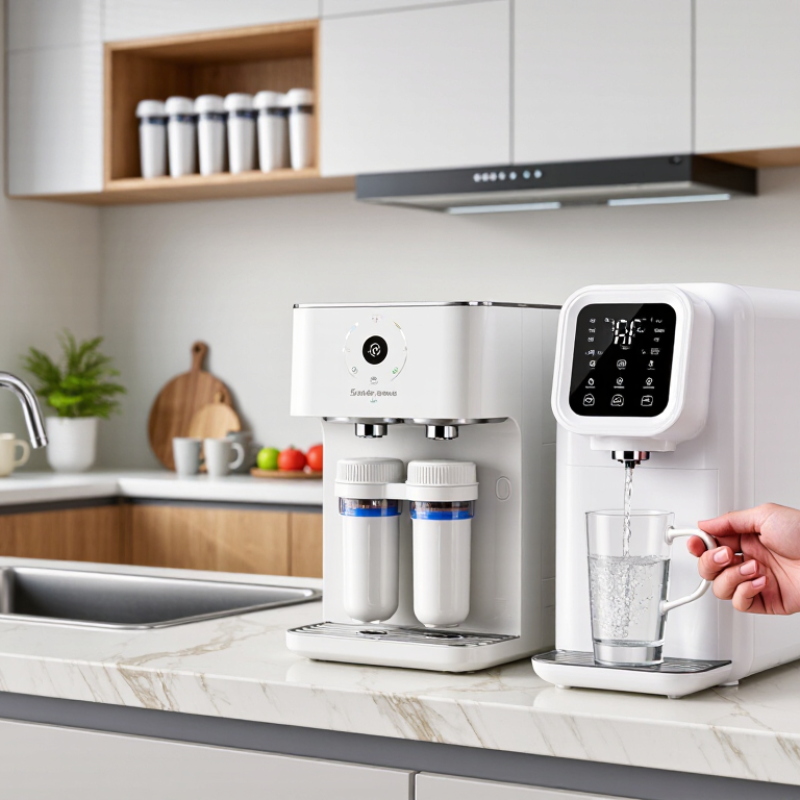
How to Choose the Best Pure Water Machine in 2026?
A reliable choice begins with water targets, not attractive features. Test your source water through an accredited laboratory when possible. Compare results with current EPA maximum contaminant levels (MCLs). For example, arsenic should remain below 0.010 milligrams per liter, while nitrate has a 10 milligrams per liter limit as nitrogen. These numbers guide treatment selection. They do not replace local requirements or professional advice.
TDS is useful, but it is not a complete safety measurement. A reading of 180 milligrams per liter may look acceptable, yet harmful contaminants can still exist. My first water plan often overweights TDS. That is a mistake. Hardness, commonly reported as calcium carbonate, predicts scale inside membranes, heaters, and faucets. Water above 120 milligrams per liter may need softening or antiscalant protection. Microbial risks require separate attention. Bacteria can multiply after treatment if storage tanks, tubing, or filters are poorly maintained.
Tips: Record TDS and hardness monthly. Replace filters by tested capacity, not guesswork. Use a certified microbial test after installation and following long storage periods. Inspect wet components for odor, slime, or cloudy water. A machine that reduces minerals may not control every pathogen. Check its tested contaminant claims carefully.
A practical target-setting table for evaluating household and point-of-use water purification systems
| Water Dimension | Reference Value or Target | Unit / Measurement Basis | What the Result Means | Potential Health or Water-Quality Concern | Purification Capability to Look For |
|---|---|---|---|---|---|
| Arsenic | EPA MCL: 0.010 mg/L | Milligrams per liter | Concentrations should be at or below the federal maximum contaminant level. | Long-term exposure may increase the risk of cancer and other health effects. | Validated arsenic reduction; reverse osmosis or an appropriately certified adsorption medium may be suitable. |
| Lead | Action level: 0.015 mg/L at the 90th percentile | Milligrams per liter; usually assessed at residential taps | Lead control focuses on corrosion prevention and tap-level monitoring rather than a conventional MCL. | Particularly harmful to infants, children, and fetuses; there is no known safe level of exposure. | Use a point-of-use filter specifically tested for lead reduction and address plumbing or corrosion sources. |
| Nitrate | EPA MCL: 10 mg/L as nitrogen | Milligrams per liter as nitrogen | Water at or below the MCL meets the federal drinking-water limit for nitrate. | High levels can cause methemoglobinemia, especially in young infants. | Reverse osmosis or ion exchange designed and tested for nitrate reduction; boiling does not remove nitrate. |
| Nitrite | EPA MCL: 1 mg/L as nitrogen | Milligrams per liter as nitrogen | Water at or below the MCL meets the federal drinking-water limit for nitrite. | Can interfere with oxygen transport in the blood, with infants at greater risk. | Use a treatment process specifically validated for nitrite; confirm performance through laboratory testing. |
| Fluoride | EPA MCL: 4.0 mg/L; secondary standard: 2.0 mg/L | Milligrams per liter | The MCL protects against skeletal fluorosis; the secondary standard addresses cosmetic dental effects. | Excessive long-term exposure can affect bones and teeth. | Reverse osmosis or activated alumina may reduce fluoride when the system is properly designed and maintained. |
| Total dissolved solids (TDS) | EPA secondary standard: 500 mg/L | Milligrams per liter; commonly estimated by conductivity meters | TDS is an aesthetic and operational indicator, not a complete measure of safety. A low TDS reading does not prove that water is pathogen-free. | High TDS may cause salty taste, scaling, staining, and reduced suitability for some appliances. | Reverse osmosis typically provides substantial TDS reduction; verify contaminant-specific performance separately. |
| Total hardness as calcium carbonate | No federal EPA MCL; common classification: soft <60 mgl, moderately hard 60–120 121–180very>180 mg/L | Milligrams per liter as CaCO3 | Hardness is mainly a scaling, taste, and cleaning concern rather than a federally regulated health limit. | Hard water can cause scale, reduce soap efficiency, and shorten the life of heating elements and membranes. | Water softening or antiscalant control for whole-home protection; reverse osmosis for drinking-water polishing. |
| E. coli | Should be absent in a 100 mL drinking-water sample | Presence or absence in 100 milliliters | Detection indicates possible fecal contamination and requires prompt investigation and corrective action. | May indicate disease-causing microorganisms, including bacteria, viruses, or parasites. | Validated microbiological barrier such as ultrafiltration, ultraviolet disinfection, or properly maintained reverse osmosis; disinfection alone does not remove chemicals. |
| Total coliform bacteria | Compliance is based on the applicable microbial treatment technique and distribution-system requirements | Usually reported as presence/absence or colony-forming units | Total coliforms are indicator organisms; a positive result can signal treatment, plumbing, or storage problems but does not by itself prove fecal contamination. | May indicate conditions that allow microbial contamination to enter or grow in the water system. | Choose a system with a validated microbiological reduction claim and maintain filters, storage tanks, and sanitary connections. |
| Turbidity | Operational target: as low as practical; public systems commonly use 0.3 NTU as a treatment-performance benchmark | Nephelometric turbidity units | Cloudiness can reduce disinfection effectiveness and may indicate suspended particles or treatment problems. | Particles can shield microorganisms and increase fouling of downstream treatment stages. | Sediment filtration or ultrafiltration before fine purification and disinfection stages. |
| pH | EPA secondary range: 6.5–8.5 | pH units | pH affects taste, corrosion, scaling, and the performance of some treatment processes. | Very low or high pH can contribute to corrosion, metal leaching, or scale formation. | Consider prefiltration, corrosion control, remineralization, or pH adjustment based on laboratory results. |
| Residual disinfectant | Follow the local utility or regulatory operating target | Usually measured as mg/L of free chlorine or chloramine | A disinfectant residual helps protect water in distribution pipes but can affect taste and odor. | Insufficient residual may permit microbial regrowth; excessive levels may create taste and odor concerns. | Activated carbon can reduce chlorine taste and odor; do not remove disinfectant without maintaining hygienic storage and plumbing. |
Selection rule: Test the source water first, identify the contaminants that exceed the desired targets, and choose a treatment process with independent performance validation for those specific contaminants. TDS meters alone cannot confirm drinking-water safety.
Reference framework: U.S. Environmental Protection Agency National Primary Drinking Water Regulations, Secondary Drinking Water Standards, Lead and Copper Rule requirements, and microbial drinking-water treatment requirements. Local limits and current regulatory requirements may differ.