A papr mask is more than a loose cover over the face. It is a powered air-purifying respirator that uses a battery-driven blower, filters, and a hood or facepiece. The blower draws contaminated air through approved filters, then delivers cleaner air into the breathing zone. This creates positive pressure inside the headtop. Small leaks may therefore push outward, rather than pull polluted air inward.
The details matter. OSHA’s Respiratory Protection Standard, 29 CFR 1910.134, requires employers to select respirators through a written program, medical evaluation, training, maintenance, and suitable fit testing. OSHA’s Assigned Protection Factor table also distinguishes loose-fitting PAPR hoods from tight-fitting respirators. Protection is not identical across designs. NIOSH certification records provide another essential checkpoint. Buyers should confirm the exact model, filter type, airflow classification, and approval number through NIOSH’s Certified Equipment List.
In practical use, the battery pack may sit at the waist while a hose runs beneath protective clothing. The blower’s steady hum can become noticeable in a quiet workshop. A clogged filter, weak battery, damaged seal, or poor maintenance can reduce performance. That sounds obvious, but workplace mistakes often begin with simple assumptions.
A papr mask can reduce inhalation exposure when selected and used correctly. It does not remove every hazard. It cannot replace ventilation, hazard assessment, or safe work procedures. CDC and NIOSH guidance repeatedly emphasize that respirators belong within a complete hierarchy of controls. No device is magic. Even professional guidance can feel incomplete without real task details, so this article examines how PAPR systems work, where their protection limits appear, and what users should verify before relying on one.
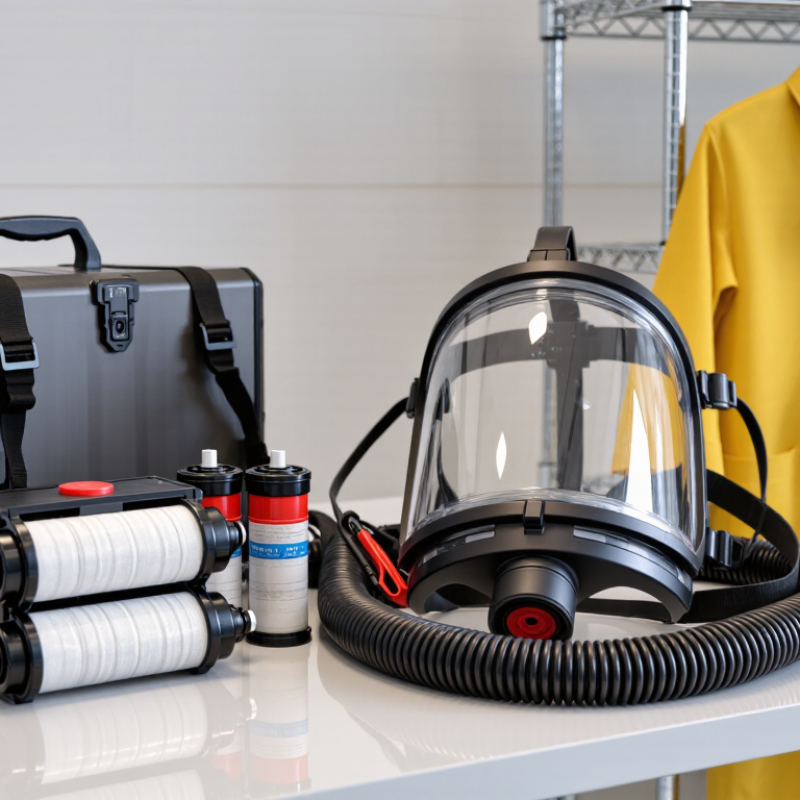
A PAPR mask is more accurately called a powered air-purifying respirator. It uses a battery-powered blower to pull contaminated air through filters or cartridges. The cleaned air then flows into a hood, helmet, or facepiece. Unlike a basic filtering facepiece, a PAPR actively moves air toward the wearer’s breathing zone. This can reduce breathing resistance during long work periods.
Its protection depends on the model, filter, seal, and workplace hazard. OSHA’s Respiratory Protection Standard, 29 CFR 1910.134, lists assigned protection factors of 25 for loose-fitting PAPRs and 50 for tight-fitting PAPRs. Some hooded systems may reach higher factors under specific conditions. These figures are not automatic guarantees. NIOSH’s Respirator Selection Logic also stresses selecting filters according to particulates, gases, vapors, and oxygen conditions.
The blower creates slight positive pressure inside the head covering. If the seal shifts, filtered air may still move outward. That is useful, but not perfect. A blocked filter can reduce airflow. A weak battery can change performance. The wearer must inspect the airflow indicator, filter condition, battery, and facepiece before use. Training and fit evaluation remain important, even when a loose-fitting hood is used. The term “mask” sounds simple. The equipment is not. Reports provide numbers, but real protection also depends on maintenance, correct selection, and disciplined use.

A powered air-purifying respirator (PAPR) uses a battery-powered blower to draw contaminated air through filters or cartridges and deliver purified air to the user’s facepiece. The chart compares OSHA-assigned protection factors (APFs) for common respirator configurations.
APF indicates the level of respiratory protection expected when a respirator is properly selected, fitted, used, and maintained. A higher APF generally permits use in higher airborne contaminant concentrations, subject to the contaminant’s limits and the respirator’s approval requirements.
Source: U.S. Occupational Safety and Health Administration, 29 CFR 1910.134, Table 1 — Assigned Protection Factors.
A PAPR system uses a battery-powered blower to move surrounding air through one or more filters. The filtered air then travels through a breathing tube into a hood, helmet, or facepiece. This steady airflow creates positive pressure inside the headgear. When the system works correctly, contaminated air is less likely to enter through small gaps.
The process starts at the intake, where a prefilter may capture larger particles. A high-efficiency filter removes fine particles, while specialized cartridges can reduce certain gases or vapors. The blower must maintain the required airflow, even as the filter collects contaminants. Most systems include an airflow indicator or alarm. That small signal matters. A low-flow warning can mean a blocked filter, weak battery, damaged hose, or poor maintenance.
In practical use, comfort can improve because the worker breathes air supplied by the blower instead of pulling air through a tight seal. Loose-fitting headgear may not require the same fit-testing method as tight-fitting respirators, but it still needs proper sizing and inspection. A PAPR does not create oxygen. It must not be used in oxygen-deficient or immediately dangerous atmospheres unless the complete system is specifically approved for that environment. It is easy to overtrust powered airflow. Battery checks, filter replacement, cleaning, and workplace hazard assessment remain essential, and real conditions may expose weaknesses that a brief equipment check misses.
A powered air-purifying respirator, or PAPR, uses a battery-powered blower to move contaminated air through filters. Its main components work as one system. The blower creates positive pressure inside the hood or facepiece. This pressure helps reduce inward leakage during normal use. NIOSH certification requirements specify minimum airflow of 6 cubic feet per minute for loose-fitting PAPRs. Tight-fitting models require at least 4 cubic feet per minute. These figures come from 42 CFR Part 84.
The filter captures particles, gases, vapors, or combined hazards, depending on its certification. A rechargeable battery powers the blower during the work period. The breathing zone includes a hood, helmet, or tight-fitting facepiece. A breathing tube connects that protection to the blower unit. Seals, valves, airflow alarms, and charging equipment also matter. Small failures matter.
OSHA lists assigned protection factors up to 1,000 for certain tight-fitting PAPR configurations. That value is conditional. Fit testing, manufacturer approval, and workplace procedures still apply. Loose-fitting hood systems generally receive a lower assigned protection factor of 25. The OSHA Respiratory Protection Standard, 29 CFR 1910.134, supports these distinctions. In practice, users should inspect filters, battery charge, airflow indicators, and tube connections before each shift. A clean-looking filter may still be saturated. This is where routine judgment can fail. Manufacturer instructions and hazard-specific assessments remain essential.
A powered air-purifying respirator (PAPR) uses a battery-powered blower to move air through filters. It draws contaminated air through a filter and delivers cleaner air into a hood, helmet, or facepiece. This positive pressure can reduce inward leakage during normal use. However, it does not create oxygen. That limit matters.
With the correct filter, PAPR systems can protect against dust, fibers, smoke, metal fumes, mists, and other airborne particles. They may also control biological aerosols, such as droplets carrying infectious material, when the equipment has suitable filtration and approval. Gas and vapor hazards require cartridges designed for those specific chemicals. A particle filter cannot remove every vapor. Filter choice depends on concentration, exposure time, airflow, and the work environment.
PAPRs are not suitable for oxygen-deficient areas, unknown hazards, or conditions considered immediately dangerous to life or health unless specifically designed and approved for them. Do not assume a running blower means complete protection. Workers should check airflow indicators, batteries, seals, filters, and facepiece condition before entering the area. Training and a written respiratory protection program remain essential. The weak point is often human judgment. Real work is messier than the manual suggests.
| Data Dimension | Key Information | Practical Significance |
|---|---|---|
| Definition | A Powered Air-Purifying Respirator (PAPR) is a respirator that uses a battery-powered blower to draw contaminated air through one or more filters or cartridges and deliver the treated air to a hood, helmet, facepiece, or headtop. | It provides respiratory protection while also creating a continuous flow of filtered air inside the breathing zone. |
| How Airflow Works | The blower pulls ambient air through the selected filter or cartridge, then sends the filtered air through a breathing tube to the head or face covering. | Positive pressure can help reduce inward leakage when the airflow is maintained and the equipment is correctly assembled and used. |
| Particle Hazards | With an appropriate particulate filter, PAPRs can protect against dusts, mists, fumes, and other airborne particles, including some biological aerosols. | Common work activities include sanding, grinding, welding, healthcare procedures, laboratory work, and handling powders. |
| Chemical Gas and Vapor Hazards | A PAPR can protect against specific gases or vapors only when it is fitted with the correct approved chemical cartridge or combination filter. | The filter type must match the contaminant. A particulate-only filter does not remove chemical gases or vapors. |
| Biological Aerosols | When equipped with a suitable high-efficiency particulate filter, PAPRs may be used for protection from airborne biological particles and aerosols. | They may be selected for tasks involving infectious aerosols, but workplace infection-control procedures and other protective measures remain necessary. |
| Eye and Face Protection | Loose-fitting hoods and helmets can cover the eyes, face, head, and neck, depending on the design and approval configuration. | This can reduce exposure to splashes and airborne particles, but the product must be approved for the intended level of protection. |
| Assigned Protection Factor | The assigned protection factor (APF) depends on the respirator class and configuration. Under U.S. occupational respiratory-protection tables, some PAPR configurations have APFs of 25, 50, or 1,000. | APF is used with the workplace exposure limit to help determine whether a respirator may be suitable. The exact value must be confirmed from applicable regulations and approval information. |
| Fit Testing | Loose-fitting PAPR hoods generally do not require the same tight-facepiece fit test, while tight-fitting PAPR facepieces require fit testing. | The employer must follow the applicable respiratory-protection program and manufacturer or regulatory requirements. |
| Oxygen-Deficient Atmospheres | A standard air-purifying respirator does not supply oxygen and must not be used as protection in an oxygen-deficient atmosphere. | Atmospheres with insufficient oxygen or unknown contaminant concentrations generally require atmosphere-supplying equipment and specialized procedures. |
| Immediately Dangerous to Life or Health | Standard PAPRs are not automatically suitable for immediately dangerous to life or health (IDLH) conditions. | Only respirator configurations specifically approved for the hazard and operating conditions should be considered for such environments. |
| Battery and Airflow | The blower must provide the required airflow for the approved configuration. Battery charge, airflow alarms, and operating time are critical factors. | Low battery, blocked filters, damaged components, or inadequate airflow can compromise protection and require immediate corrective action. |
| Filter and Cartridge Selection | Filters and cartridges are designed for particular contaminant classes and have service-life limitations. | Selection should be based on the contaminant, concentration, exposure limit, humidity, temperature, and the respirator approval configuration. |
| Main Advantages | PAPRs can reduce breathing resistance compared with many negative-pressure respirators and may be more comfortable for extended use. | They can be useful for workers who have difficulty tolerating tight-fitting respirators, subject to medical evaluation and program requirements. |
| Limitations | PAPRs do not remove every possible hazard, do not replace hazard controls, and may restrict mobility because of the blower, battery pack, and breathing tube. | A complete risk assessment is required before selecting a PAPR for a specific task or environment. |
| Required User Practices | Users need training, medical evaluation where required, pre-use inspection, correct donning, cleaning, maintenance, storage, and timely replacement of filters or cartridges. | Correct use and maintenance are essential because a properly designed respirator can still fail to protect if it is damaged, incorrectly configured, or poorly maintained. |
Note: Respirator selection should be based on a documented hazard assessment and the applicable occupational-safety requirements. Always verify the approved configuration, limitations, and operating instructions before use.
A PAPR mask uses a battery-powered blower to pull contaminated air through filters. It then delivers cleaner air into a hood, helmet, or facepiece. Selection should begin with a documented hazard assessment, not comfort alone. Identify the contaminant, concentration, oxygen level, and required protection factor. Choose a unit certified for the intended hazard and work environment. Chemical vapors, fine particles, and low-oxygen areas may require different equipment. A PAPR is not suitable for oxygen-deficient atmospheres unless specifically designed and approved for that use.
Check airflow, battery duration, weight, noise, and visibility before purchase. The wearer should understand alarms and breathing resistance. Loose-fitting designs may reduce fit-testing demands, but they still need correct airflow and a secure seal around the neck or face. Facial hair, glasses, heat, and communication needs can affect performance. Sometimes, the most comfortable option is not the safest. That deserves honest review.
Tips: Inspect the hood, hose, blower, battery, and seals before every use. Confirm airflow with the supplied indicator or test method. Replace filters according to measured loading, damage, odor breakthrough, or manufacturer guidance; do not wash disposable filters. Clean reusable surfaces with approved methods, then dry them fully. Store the unit away from dust, sunlight, chemicals, and extreme temperatures. Charge batteries as instructed, and record inspections and filter changes. A simple log prevents memory-based decisions, although busy teams may still miss entries. Have a trained safety professional review unclear hazards and maintenance failures.