China Top Face Shield Mask Manufacturers and Suppliers
China has become an important sourcing hub for face shield mask manufacturers and suppliers. Its production network covers injection molding, PET film processing, packaging, and private-label services. However, supplier quantity does not guarantee product quality. Buyers must examine the entire supply chain.
A dependable face shield mask should provide clear vision, stable coverage, comfortable wearing, and practical cleaning options. Look closely at the visor material, optical distortion, headband pressure, foam placement, and anti-fog treatment. Small details matter. A loose elastic band may cause repeated adjustment. Poor film clarity can make a busy clinical or industrial environment more tiring. These issues are easy to miss in product photographs.
Dr. Anthony Fauci stated, “The face shield should be used in addition to a mask, not instead of a mask.” This guidance remains important when evaluating manufacturers and suppliers. A face shield can help reduce exposure to droplets and splashes, but it does not replace a complete protective strategy. Responsible companies should explain product limitations clearly. They should also provide sample inspections, material information, production records, and transparent quality-control procedures.
This guide examines China-based face shield mask manufacturers through practical purchasing criteria. These include customization capability, minimum order quantities, lead times, export experience, packaging quality, and communication reliability. Certifications may be useful, but buyers should verify their scope and authenticity. Some suppliers look impressive online. Their samples may tell a different story. Careful testing is still necessary. A better supplier is not always the cheapest one; it is the one that delivers consistent, traceable, and suitable protection for the intended application.
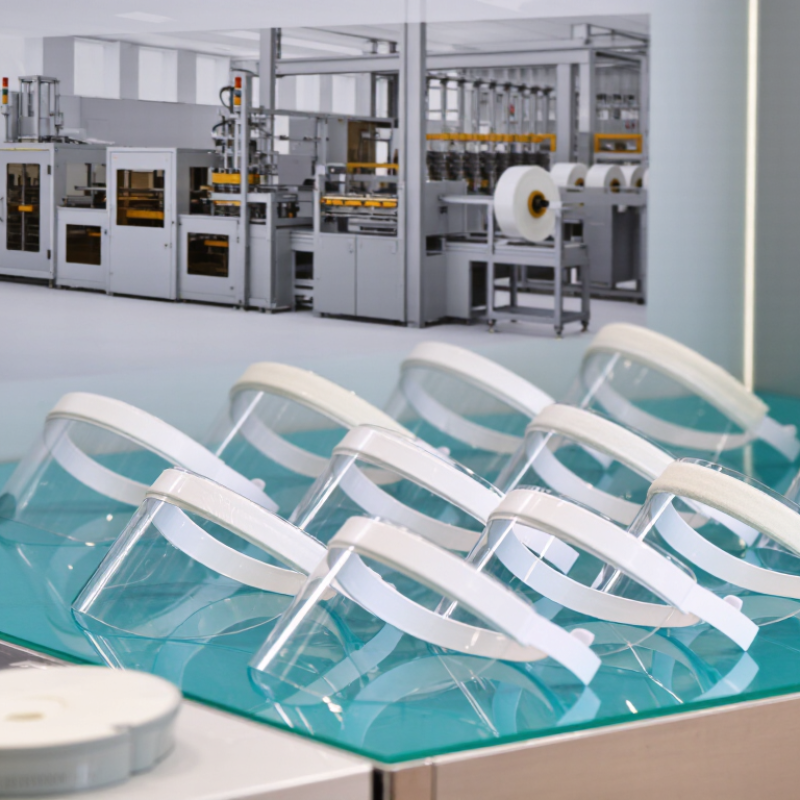
What Is a Face Shield Mask and How Does It Work?
A face shield mask is a clear visor worn in front of the face. It usually includes a forehead band, side coverage, and a chin extension. The visor acts as a physical barrier against droplets, splashes, and larger airborne particles. It helps protect the eyes, nose, and mouth during close work. However, it does not seal around the face.
Air moves through the open sides and bottom. For this reason, a face shield should not replace a suitable protective mask when fine particles or aerosols are a concern. Its main value is reducing direct contact with fluid and discouraging people from touching their faces. A well-designed shield should provide wide peripheral vision, stable positioning, and enough space for normal breathing. Anti-fog treatment also matters in warm, humid workplaces.
Fit changes performance. The forehead band should feel secure without causing pressure, while the lower edge should extend below the chin. Scratches, loose straps, and fogging can reduce visibility and encourage unsafe adjustments. Clean the visor after use with a method suitable for its material, then inspect it under bright light. Do not assume a larger shield is always better. It may feel safer, yet poor balance can make it slip. No shield is perfect. Selecting the right design requires considering the task, movement, ventilation, and other protective equipment used nearby.
Major Types of Face Shield Masks Made in China
China’s face shield manufacturers produce several types for clinics, laboratories, factories, schools, and public-facing work. The standard clear shield uses PET or polycarbonate film, an elastic band, and a soft forehead cushion. PET is light and affordable, while polycarbonate usually offers better impact resistance. The choice depends on the working environment.
Medical anti-fog shields are another major type. Their treated surface helps maintain visibility during long procedures, especially when temperature changes cause condensation. Some suppliers add side coverage, a wrapped visor, or a disposable foam strip. These details seem small. They affect comfort greatly.
Reusable full-face shields often use thicker frames and replaceable visors. Workers can clean them between shifts, but cleaning chemicals may damage coatings or reduce clarity. Disposable models are lighter and practical for short tasks. Adjustable designs fit over glasses and protective masks, although head sizes vary more than product samples suggest. Helmet-mounted shields serve construction and industrial users, with stronger brackets and wider coverage. During supplier checks, buyers should review material thickness, optical clarity, hinge strength, and batch records. Anti-fog performance should be tested under realistic heat and humidity, not only in a showroom. No face shield replaces suitable respiratory protection, and poor adjustment can leave gaps. I have found that comfort testing is often overlooked, yet users remove uncomfortable shields quickly.
This chart compares common face shield mask categories manufactured in China by the number of physical protection zones they typically cover: eyes, nose and mouth, chin, and the front neck area. It represents product design characteristics rather than company sales, market share, or brand data.
How to Evaluate Chinese Manufacturers and Suppliers
When evaluating Chinese face shield mask manufacturers, verify the factory before comparing prices. The WHO and UNICEF PPE supply-chain assessment estimated global monthly needs of 89 million medical masks and 1.6 million goggles in 2020. This scale exposed weak traceability across the industry. Ask for business licenses, production photos, factory addresses, and recent audit records. A trading company may still be useful, but its role should be clear.
Request samples from the same production line. Check optical clarity, headband tension, edge finishing, splash coverage, and hinge durability. Test the shield after repeated cleaning, not only when it looks new. Ask whether materials have batch records and whether incoming plastic is inspected. For occupational use, confirm testing against the relevant standard, such as ANSI/ISEA Z87.1 or EN 166. Do not accept a certificate without checking its scope, issuing laboratory, date, and test model.
Capacity claims need evidence. Compare stated output with machine numbers, worker shifts, packaging records, and lead-time history. Ask for a pre-shipment inspection and retain sealed samples from each batch. Small details matter. A loose strap can ruin an otherwise strong product. Product photos can mislead. I have seen specifications change between samples and quotations, which is a warning sign. Payment terms, defect handling, replacement rules, and document control should be written clearly. Some evaluations still overlook packaging compression during ocean transport. That mistake is expensive.